
Dangers of Using Water Under Fire Blankets During EV Fires
Volume 8, Issue 2, April – June 2025
Dangers of Using Water Under Fire Blankets During EV Fires
Dr. Arindam Bhadra
Director of SSA Integrate, 20+ Years Experience in The Field of Design Inspection Consultancy Commissioning with NFPA Certifications. Certified Fire Inspector and ISO Lead Auditor. Member Of NFPA, ISEI, FSAI, Natonal Safety Council
Email id: ssaintegrate@gmail.com
Abstract
Using fire blankets on electric vehicle (EV) fires can be dangerous due to the potential for flammable gas buildup and subsequent explosion when the blanket is removed. While blankets can initially suppress flames by cutting off oxygen, they don’t stop thermal runaway, which continues to release flammable gases. This accumulation of gases under the blanket can create an explosion risk, especially when reintroduced to oxygen.
Introduction
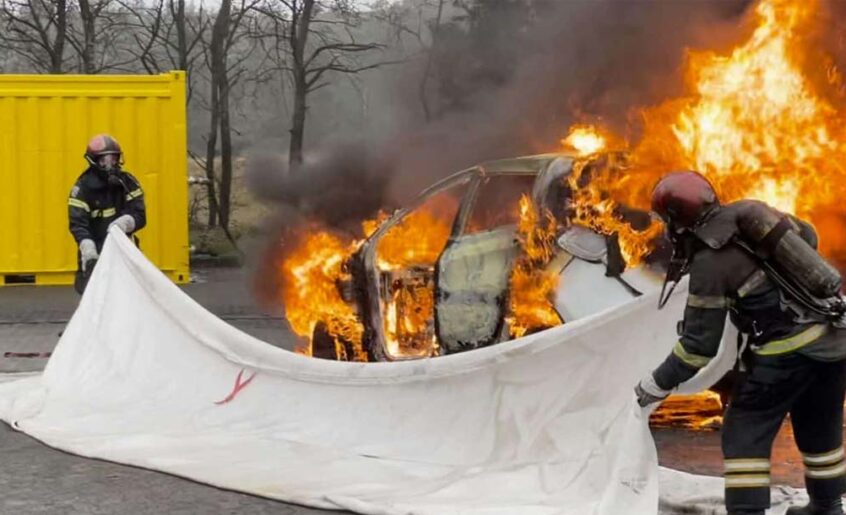
Two serious electric vehicle (EV) fire incidents – one in the USA and one in Norway – have recently highlighted a dangerous misuse of EV fire blankets. In both cases, water was introduced under the blanket, leading to explosions. Fortunately, no injuries occurred. However, these incidents were the result of clear user errors, contrary to our safety protocols. This document explains what happened, why it happened, and most importantly, how to prevent it from happening again.
The Fire Protection Research Foundation (FPRF), the research affiliate of the National Fire Protection Association (NFPA), jointly announced the findings with FSRI on May 30, 2025. On this June 2025 we did some telephonic discussion regarding this with Mr. Frank Brubakken, founder of Bridgehill. Scientific literature has thoroughly documented that introducing water into environments containing flammable gases, particularly those released during thermal runaway of lithium-ion batteries, can significantly worsen the risk of fire and explosion. This is due to several chemical and physical reactions triggered by water interacting with battery components and released gases.
Reactions Between Water and Lithium-Ion Batteries
During thermal runaway, lithium-ion batteries can emit various flammable and toxic gases, including hydrogen, methane, and carbon monoxide. When water is introduced, it may react with exposed lithium or other reactive battery components, leading to the generation of hydrogen gas. Hydrogen is extremely flammable and, when mixed with oxygen, forms an explosive mixture known as ‘oxyhydrogen’. This mixture can ignite at relatively low temperatures and energy levels, dramatically increasing the risk of explosion.
“During thermal runaway, gases such as hydrogen (H₂), methane (CH₄), and carbon monoxide (CO) are released, which may cause fire or explosion.”
https://mozees.no/phd-blog-why-do-lithium-ion-batteries-catch-fire-or-explode/
“Water can react with battery components and generate hydrogen gas… creating an explosive mixture when combined with air.”
https://www.ufinebattery.com/blog/can-lithium-batteries-be-in-the-water
“Lithium reacts with water to produce hydrogen gas, which is highly flammable… increasing the risk of explosion.”
https://poweringautos.com/can-water-put-out-a-lithium-ion-battery-fire/?utm_
Why You Should NEVER Use Water Under the Blanket
Using water in the oxygen-poor environment under the fire blanket can cause:
- Steam and pressure build-up that spreads flammable gases.
- Homogeneous gas-air mixtures that become explosive when oxygen is introduced
- Increased risk of backfire when lifting or disturbing the blanket, allowing oxygen in.
- Risk of ignition from static electricity or heat transfer caused by water.
Clarification of the Incident in the USA
The test was conducted by authorities and the fire department. The procedures followed – including the use of water both inside and outside the blanket – were NOT inaccordance with our protocols. This can be compared to using water on a grease fire: extremely dangerous and strongly discouraged.
Fortunately, no one was injured.
The Fire Protection Research Foundation (FPRF) is conducting research to improve the safety of firefighters responding to electric vehicle fires and incidents by assessing current firefighting tactics and tools used by the fire service to manage EV incidents and the impact of suppression activities on managing re-ignition risks. Recent experiments for the Assessment of EV Firefighting Tactics, Tools and the Impact on Stranded Energy research project were conducted to assess the ability of four firefighting tactics to suppress and establish control of fire incidents involving standalone electric vehicle battery packs and full electric vehicles with confirmed battery pack fire involvement: standard hose stream application – water only; standard hose stream application – with injected agent; electric vehicle fire blankets; and firefighting appliances.
Technical Clarifications
It is important to understand that the fire blanket does not extinguish the EV battery itself. The blanket isolates the fire and immediately eliminates about 80% of the fire, which mainly come from burning plastics and other organic materials. These are extinguished almost instantly.
The battery may still continue to burn. But once the organic materials no longer burn, the temperature around the battery decreases. This can prevent or slow propagation between battery cells, meaning the fire develops more slowly and eventually stops earlier than if the vehicle were fully engulfed.
Bridge hill has also developed a new solution to prevent fire from spreading between battery modules. This technology is designed to make batteries produced significantly safer in the future.
There is a need to align standards and procedures for global use of fire blankets. I am available to help establish this to ensure safe usage worldwide. There are several unserious actors trying to implement water use as part of their procedure without proper knowledge and using seams and fabrics that do not meet the high quality needed for an EV fire. It is difficult to discern who is serious and who is not. Even certification bodies exploit this trend by creating their own certifications for profit. Here we also see a lack of expertise.
On July 2025 the IAFF recommends members do not use fire blankets on EV fires involving the battery. Electric vehicle (EV) fires have presented unique suppression challenges to the fire service.
The IAFF has been involved in battery research for 10 years and has developed the following conclusions:
- The IAFF has not been presented with any full-scale testing by independent researchers that demonstrates that any available product improves the performance of water when responding to battery fires.
- The IAFF has not been presented with any full-scale testing by an independent researcher that demonstrates the effective use of available products to reduce the risk of exposure to carcinogens when responding to an EV or any fire.
- The IAFF recommends the application of water to open flaming in response to EV fires. See the IAFF Energy Hazard Guide.
These recommendations will remain in place until industry standards are developed to certify the use of fire blankets and demonstrate their safe deployment at an EV fire or upon validation that the use of fire blankets during EV fires is effective and safe through full-scale, verified independent research.
Conclusion
Fire blankets can play a role in the initial containment and suppression of flames during an EV fire, but they are not a complete solution. The ongoing thermal runaway and the risk of gas accumulation and explosion necessitate a cautious approach and highlight the need for continued research into safer and more effective firefighting tactics and tools for EV fires. According to International Fire & Safety Journal, organizations like the NFPA and UL Research Institutes are actively working on addressing these challenges and improving safety protocols for emergency responders.
Reference
- IAFF research Paper
- Fire Protection Research Foundation (FPRF) research paper