
Engineering Democracy Safely: The H.A.R.M.O.N.Y. Framework for Political Campaign Risk Management
Volume 8, Issue 3, July-September 2025
Engineering Democracy Safely: The H.A.R.M.O.N.Y. Framework for Political Campaign Risk Management
Dr. Senthilkumar Anantharaman
Email id: senthilkumara1851@gmail.com
Abstract
Political campaigns represent vibrant expressions of democracy, yet their large-scale
mobilisations frequently expose participants to significant safety hazards—structural,
electrical, vehicular, and crowd-related. Recent incidents, including the Karur rally disaster in
Tamil Nadu, have revealed systemic lapses in safety planning and inter-agency coordination
that demand urgent attention from both safety engineering and public policy perspectives. This
study extends safety engineering principles to the political domain by developing a conceptual
model—the H.A.R.M.O.N.Y. Framework (Hazard Analysis, Risk Mitigation, and Oversight
for Non-industrial Yields). Drawing from system safety literature, accident models such as
STAMP (Leveson, 2012), the Swiss cheese model (Reason, 1997), and contemporary risk
governance approaches, the framework provides a cyclical mechanism to anticipate, mitigate,
and learn from campaign-related accidents. Applying H.A.R.M.O.N.Y. retrospectively to the
Karur case highlights its potential to reduce preventable fatalities through structured hazard
identification, real-time monitoring, and organisational feedback loops. The study concludes
with strategic recommendations for institutionalizing safety engineering as a mandatory
dimension of democratic process management, proposing a Safety Certification System
analogous to environmental clearances in industrial sectors.
Keywords:
Safety, Hazard identification, Political campaign risk management, Risk categorization & Mitigation, Democracy safety, H.A.R.M.O.N.Y. framework, Electoral risk mitigation, Campaign security, Governance and accountability, Political process safety
Objective:
To provide a structured framework (H.A.R.M.O.N.Y.) for identifying, assessing, and mitigating risks in political campaigns, ensuring safe, transparent, and effective democratic processes.
1. Introduction
Political campaigns in India constitute some of the most logistically complex and densely
populated events in the world, seamlessly blending political fervour, extraordinary human
density, and infrastructural improvisation on scales rarely witnessed elsewhere (Kumar &
Singh, 2018). Each rally, motorcade, or roadshow temporarily transforms public spaces into
high-risk socio-technical systems, involving hastily constructed stages, improvised electrical
networks, complex traffic management scenarios, and unpredictable crowd flow dynamics.
Despite their frequency and the millions of participants they attract during election seasons,
systematic safety engineering protocols remain conspicuously absent from campaign planning
frameworks (NDMA, 2016; Rao & Mehta, 2019).
The historical record of disasters at political events, including electrocutions from campaign
vehicles, crowd stampedes, structural collapses of temporary platforms, and vehicle accidents,
has exposed severe gaps in design thinking, hazard anticipation, and preventive oversight
(Sharma, 2020). The mass casualty event at the Karur rally in 2025, where poor crowd control
and logistical failures resulted in a deadly stampede, highlights a profound flaw in systemic
safety management. This tragedy serves as a poignant and critical demonstration that the
pursuit of democratic engagement must be protected from fatal, preventable risks. This paper
argues that such accidents are not random failures or acts of fate but rather predictable system
level breakdowns that demand a structured safety engineering response. Drawing upon established accident causation models, particularly Reason’s (1997) “Swiss cheese model” of
organisational accidents and Leveson’s (2012) system-theoretic accident model and processes
(STAMP), we introduce the H.A.R.M.O.N.Y. Framework, a multi-layered, adaptive model
designed to embed safety engineering principles within the fabric of political campaign
management.
1.1 Research Objectives
This study pursues three interconnected objectives:
- To systematically analyse the nature and typology of safety hazards present in political
campaign environments through the lens of safety engineering - To develop a comprehensive, theoretically grounded framework (H.A.R.M.O.N.Y.) that
integrates hazard identification, risk assessment, mitigation strategies, and
organisational learning mechanisms - To demonstrate the framework’s applicability through retrospective analysis of the
Karur rally incident and propose policy mechanisms for institutionalising campaign
safety
1.2 Significance of the Study
The significance of this research extends beyond immediate safety concerns to address
fundamental questions about the engineering of democratic spaces. As Dekker (2011) argues,
complex systems failure often results not from individual errors but from drift in organisational
practices and the gradual normalisation of deviance. Political campaigns, with their compressed
timelines, political pressures, and volunteer-dependent operations, are particularly susceptible
to such drift. By applying rigorous safety engineering methodologies to this domain, we can
transform ad-hoc political gatherings into systematically managed events that honour both
democratic participation and human safety.
2. Literature Review
2.1 Safety Engineering Foundations and Systems Thinking
Safety engineering has traditionally evolved within industrial, aerospace, and nuclear sectors,
where design redundancy, hazard analysis, and risk management are codified through
international standards such as ISO 31000:2018, IEC 61508, and AS/NZS 4360 (Hopkins,
2014). These frameworks rest on fundamental principles: that accidents are preventable
through systematic analysis, that safety must be designed into systems rather than added
afterwards, and that organisational learning from near-misses and failures is essential for
continuous improvement (Leveson, 2012).
The evolution of safety thinking has progressed through several paradigmatic shifts. Early
safety engineering focused on component reliability and technical failures—what Hollnagel
(2014) terms “Safety-I,” characterised by reactive responses to things that go wrong.
Contemporary approaches, particularly resilience engineering, embrace “Safety-II” thinking,
which emphasises understanding how things go right and building adaptive capacity into
systems (Hollnagel, Woods, & Leveson, 2006).
Leveson’s (2012) STAMP (System-Theoretic Accident Model and Processes) represents a
significant advancement in safety thinking by moving beyond linear chain-of-events models to
recognise accidents as emergent properties of complex systems. STAMP emphasises control
structures, feedback loops, and the enforcement of safety constraints across organisational
hierarchies—concepts directly applicable to the multi-agency coordination required in
campaign management.
However, political gatherings are rarely conceptualised as engineered systems requiring formal
safety architecture. This gap in thinking has led to repeated incidents and a persistent inability
to learn from failures across different political contexts (Challenger, Clegg, & Robinson, 2009).
2.2 Accidents in Political and Mass Gathering Contexts
The academic literature on mass gathering safety has primarily focused on religious
pilgrimages, sporting events, and music festivals rather than political campaigns (Memish et
al., 2012; Still, 2014). Studies of events such as the Hajj pilgrimage, Kumbh Mela, and major
concerts demonstrate that accidents often result from organisational complexity, inadequate
crowd modelling, and weak control structures rather than individual negligence (Helbing,
Johansson, & Al-Abideen, 2007).
Political campaigns share similar dynamics with these mass gatherings but differ in critical
ways that exacerbate risk profiles. Unlike planned festivals with dedicated infrastructure,
political rallies involve voluntary participation, ad-hoc infrastructure, intense political pressure,
compressed planning timelines, and frequently, a culture of risk tolerance driven by
competitive electoral dynamics (Rao & Mehta, 2019). The temporary nature of campaign
structures, combined with the symbolic importance of crowd size in political messaging,
creates perverse incentives that prioritise mobilisation over safety.
Challenger et al. (2009) identified key factors in crowd-related incidents, including inadequate
ingress and egress planning, information failures, and breakdown in crowd-authority
communication. Their work emphasised that crowd disasters typically result from systemic
failures rather than crowd irrationality, a finding that aligns with modern safety engineering’s
emphasis on system design over individual blame.
2.3 Organizational Safety Culture and High-Reliability Organizations
The concept of safety culture, originally developed in response to major industrial disasters
like Chernobyl and the space shuttle Challenger accident, emphasises that organisational
attitudes, values, and practices fundamentally shape safety outcomes (Reason, 1997; Vaughan,
1996). High-reliability organisations (HROs)—such as aircraft carriers and nuclear power
plants—maintain extraordinary safety records despite operating in high-risk environments by
cultivating specific organisational characteristics: preoccupation with failure, reluctance to
simplify interpretations, sensitivity to operations, commitment to resilience, and deference to
expertise (Weick & Sutcliffe, 2015).
Political campaign organisations rarely exhibit HRO characteristics. Campaign teams typically
prioritise political messaging, logistics, and mobilisation, with safety considerations relegated
to minimal police coordination. The absence of dedicated safety professionals in campaign
planning teams, combined with the temporary nature of campaign organisations, prevents the
development of institutional safety memory (Sharma, 2020).
2.4 Risk Governance and Multi-Agency Coordination
Contemporary risk governance frameworks recognise that managing complex risks requires
coordination across multiple organisational boundaries, stakeholder engagement, and
integration of diverse knowledge systems (Renn, 2008). The International Risk Governance
Council (IRGC) framework emphasises the need for systematic risk assessment, evaluation,
management, and communication—all elements conspicuously absent in current campaign
management practices.
Multi-agency coordination presents particular challenges in campaign contexts where authority
is distributed among political organisations, police departments, local governments, electricity
boards, traffic management agencies, and emergency medical services. Without clear command
structures and communication protocols, these agencies often operate in silos, creating
dangerous gaps in safety coverage (NDMA, 2016).
2.5 Gap in Literature: Engineering-Based Frameworks for Campaign Safety
While the NDMA (2016) provides valuable crowd management guidelines focused primarily
on law enforcement perspectives, there remains a critical gap in engineering-based frameworks
specifically applicable to campaign logistics. Existing industrial safety models assume formal
work systems with clear authority, documentation, and boundaries—characteristics often
absent in political campaigns. What is needed is a framework that integrates human factors
engineering, organisational safety culture, and systemic learning mechanisms while remaining
flexible enough to adapt to the fluid, politically charged environment of campaigns.
This study addresses this gap by developing the H.A.R.M.O.N.Y. Framework, which
synthesises insights from multiple safety disciplines into a unified model suitable for transient
public systems.
3. Methodological Approach
This paper adopts a conceptual systems engineering approach that combines multiple analytical
methodologies to create a comprehensive safety framework. The methodology integrates
theoretical development with practical application through retrospective case analysis.
3.1 Research Design
The research follows a qualitative, model-building approach grounded in established safety
engineering methodologies:
Failure Mode and Effects Analysis (FMEA): Used for systematically identifying and
classifying potential hazards in campaign environments, assessing their severity, likelihood,
and detectability (Stamatis, 2003). This method provides structured templates for hazard
documentation and prioritisation.
System-Theoretic Process Analysis (STPA): Applied for modelling control structures, feedback
mechanisms, and safety constraint enforcement across organisational boundaries (Leveson,
2012). STPA’s strength lies in identifying hazardous control actions and inadequate feedback
loops before they manifest as accidents.
Root Cause Analysis (RCA) and Post-Event Reviews (PER): Employed for learning integration
and capturing institutional knowledge from incidents. RCA techniques, including the “5 Whys”
and fishbone diagrams, help identify systemic causes beyond proximate triggers (Rooney &
Heuvel, 2004).
Comparative Analysis: Drawing insights from analogous high-risk systems, including aviation
ground operations, concert venue management, and construction site safety to identify
transferable safety principles.
3.2 Validation Approach
The research follows a qualitative validation approach, applying the developed framework
retrospectively to the Karur rally incident as an illustrative case. This retrospective application
serves multiple purposes: demonstrating the framework’s analytical utility, identifying specific
failure points that the framework would address, and illustrating how systematic application
could have prevented the tragedy.
The objective is not empirical measurement of incident rates or statistical validation but rather
model-based reasoning for policy and design reform. This approach aligns with conceptual
modelling traditions in safety engineering, where frameworks are first developed theoretically,
then refined through practical application and expert validation (Leveson, 2012).
3.3 Methodological Contribution
The present study contributes methodologically to safety engineering in three distinct ways—
conceptual extension, systemic synthesis, and domain adaptation—each expanding the
boundaries of traditional safety research.
Conceptual Extension of Safety Engineering Principles: Traditional safety methodologies such
as HAZOP (Hazard and Operability Study), FMEA, and STPA are designed for industrial
systems where operations, roles, and environments are well defined, stable, and repeatable.
Political campaigns, by contrast, represent temporary, open, and socio-technically unstable
systems characterised by fluid authority structures, volunteer workforces, and compressed
timelines. The H.A.R.M.O.N.Y. Framework extends these established methods into such non
industrial contexts by creating a flexible, modular structure that adapts the rigour of
engineering analysis to dynamic, people-centred environments. This conceptual extension
transforms safety engineering from a primarily technical field into a socio-technical systems
discipline capable of governing fluid human systems.
Systemic Synthesis Across Multi-Disciplinary Inputs: The framework synthesises insights
from systems theory (Leveson, 2012), organisational accident modelling (Reason, 1997),
resilience engineering (Hollnagel, 2014), and risk governance (Renn, 2008) into a unified
model suitable for transient public systems. It integrates both top-down hazard control
(engineering standards and regulatory oversight) and bottom-up behavioral adaptation
(learning feedback and organizational memory), producing a closed-loop control architecture
that balances prescriptive and adaptive safety mechanisms. This synthesis ensures that each
H.A.R.M.O.N.Y. component—Hazard identification, Assessment, Risk mitigation,
Monitoring, Oversight, Normalization, and Yield—forms a recursive learning cycle rather than
a linear compliance checklist.
Domain Adaptation to Non-industrial, High-Density Systems: Most existing safety
methodologies assume formal work systems with clear hierarchies, documented procedures,
and defined boundaries. Political rallies and campaign events lack these attributes, operating
instead through informal networks, political urgency, and volunteer coordination. The
methodological innovation here lies in adapting engineering-level controls to socio-political
systems through proxy parameters such as crowd density metrics, stage load calculations,
vehicle clearance assessments, and inter-agency communication reliability measures. Thus, the
framework provides a transferable methodological bridge from industrial process safety to
democratic process safety—a novel conceptual space not yet codified in safety science
literature.
Overall, the H.A.R.M.O.N.Y. model’s methodological novelty lies in its ability to transform
unregulated, ephemeral events into auditable safety systems through an engineering mindset.
By fusing analytical rigor with democratic inclusivity, it reframes political campaign
management as a legitimate object of safety engineering inquiry and intervention.
4. The H.A.R.M.O.N.Y. Framework: A Safety Engineering Architecture
4.1 Conceptual Definition and Philosophy
H.A.R.M.O.N.Y. extends the system safety paradigm to non-industrial, high-density political
environments. The framework’s philosophy is grounded in two complementary principles:
safety by design and learning by reflection. The name itself embodies the framework’s
aspirational goal: achieving harmony among human enthusiasm, technical infrastructure, and
environmental constraints within democratic spaces.
The framework recognises that political campaigns represent complex adaptive systems where
safety emerges from the interaction of multiple components rather than from any single control
mechanism.
Following STAMP’s system-theoretic approach (Leveson, 2012), H.A.R.M.O.N.Y. emphasises:
- Control structures that enforce safety constraints across organisational boundaries
- Feedback loops that enable real-time adaptation and post-event learning
- Hierarchical coordination that balances local autonomy with systemic oversight
- Constraint enforcement that maintains safety boundaries without stifling democratic
expression
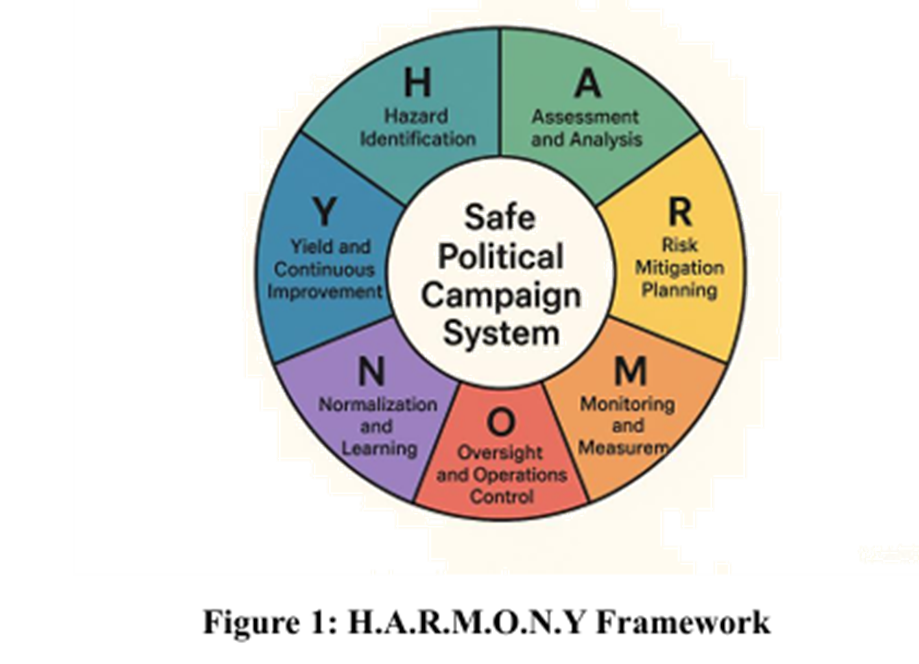
The Framework is shown in Figure 1.
4.2 Framework Components: Detailed Exposition
H – Hazard Identification
Definition: Systematic recognition of structural, electrical, meteorological, vehicular, and
crowd-related hazards through comprehensive site surveys and route assessments.
Theoretical Foundation: Drawing from FMEA methodologies, this phase involves proactive
identification of failure modes before they manifest. Hazard identification must be
comprehensive, covering all phases of the campaign event lifecycle from planning through
post-event dispersal (Stamatis, 2003).
Key Activities in Political Campaigns:
- Conduct pre-event electrical mapping using GIS technology to identify overhead power
lines, transformers, and substations along procession routes - Perform structural audits of temporary stages, platforms, and scaffolding using load
calculation standards - Assess meteorological forecasts for weather-related hazards including lightning, high
winds, and extreme temperatures - Evaluate crowd flow patterns using site topology analysis and historical attendance data
- Identify vehicular hazards including route obstacles, traffic conflict points, and
emergency access routes
Implementation Requirements:
- Deploy multi-disciplinary hazard identification teams including electrical engineers,
structural engineers, and crowd safety specialists - Utilize technology tools including drone surveys, GIS mapping platforms, and 3D
modelling software - Establish standardized hazard checklists specific to political campaign contexts
- Create hazard registers documenting identified risks with photographic evidence and
GPS coordinates
A – Assessment and Analysis
Definition: Quantitative and qualitative evaluation of identified hazards to determine severity,
probability, and overall risk level.
Theoretical Foundation: Risk assessment methodologies from ISO 31000:2018 provide
structured approaches to evaluating consequences and likelihoods. The assessment phase
transforms identified hazards into prioritized risks requiring intervention (ISO, 2018).
Key Activities:
- Apply FMEA scoring systems assigning severity (S), occurrence (O), and detection (D)
ratings to each identified hazard - Calculate Risk Priority Numbers (RPN = S × O × D) to prioritize mitigation efforts
- Conduct STPA analysis to identify unsafe control actions and inadequate feedback
mechanisms - Document findings in a comprehensive campaign safety register with visual risk
matrices - Engage stakeholder workshops to validate risk assessments and incorporate local
knowledge
Risk Categorisation:
- Critical risks: Potential for multiple fatalities or mass casualties (e.g., structural
collapse, major electrical hazards) - Serious risks: Potential for significant injuries or limited fatalities (e.g., crowd crushes,
vehicle accidents) - Moderate risks: Potential for minor injuries or property damage (e.g., minor electrical
shocks, trip hazards) - Low risks: Minimal injury potential but requiring documentation (e.g., audio equipment
failure, minor weather impacts)
R – Risk Mitigation Planning
Definition: Development and implementation of engineered, administrative, and behavioural
controls to eliminate or minimize identified hazards.
Theoretical Foundation: The hierarchy of controls—elimination, substitution, engineering
controls, administrative controls, and personal protective equipment—provides a systematic
approach to risk reduction (NIOSH, 2015).
Key Activities:
- Apply insulation standards to all metallic campaign materials including flagpoles,
sound equipment, and decorative structures - Conduct structural stability testing using engineering calculations for load-bearing
capacity - Implement crowd density controls through physical barriers, multiple entry/exit points,
and capacity limits - Establish clear height restrictions for campaign vehicles with visual markers and
measuring devices - Develop emergency response protocols including evacuation procedures and medical
support positioning - Create administrative controls including safety briefings, permission systems, and
safety officer appointments
Mitigation Strategies by Hazard Type: - Electrical hazards: Route modification, insulated materials, clearance enforcement,
power line burial or insulation - Structural hazards: Professional engineering design, load testing, anchoring systems,
redundant support structures - Crowd hazards: Flow modelling, capacity limits, real-time density monitoring, trained
stewards - Vehicular hazards: Speed limits, professional drivers, vehicle inspection, designated
pedestrian zones
M – Monitoring and Measurement
Definition: Real-time observation and documentation of risk indicators, safety compliance, and
emerging hazards throughout the event lifecycle.
Theoretical Foundation: Dynamic risk management requires continuous monitoring with
feedback mechanisms enabling rapid response to changing conditions (Hopkins, 2014).
Key Activities:
- Deploy IoT-based sensors for structural stress monitoring on temporary platforms
- Utilize drone surveillance for crowd density assessment and real-time flow pattern
analysis - Implement crowd analytics using computer vision technology to detect dangerous
density levels - Install weather monitoring stations providing real-time alerts for meteorological
hazards - Position safety observers at critical control points with direct communication to
command centres - Maintain continuous electrical monitoring of isolation distances and grounding systems
Technology Integration:
Sensor networks transmitting data to centralized dashboards
- Mobile applications enabling distributed safety reporting by stewards
- Real-time communication systems linking field observers to command centres
- Automated alert systems triggering interventions when parameters exceed safety
thresholds
O – Oversight and Operations Control
Definition: Coordination of multi-agency safety teams through clear command protocols and
communication structures.
Theoretical Foundation: Incident Command System (ICS) principles provide proven
frameworks for managing complex multi-agency operations (FEMA, 2008). Effective
oversight requires clear authority, defined responsibilities, and structured communication.
Key Activities:
- Establish Safety Command Cells integrating engineers, police, medical services, and
event organisers - Implement Unified Command structures with clear decision-making authority
- Develop Standard Operating Procedures (SOPs) for various hazard scenarios
- Conduct pre-event coordination meetings with all stakeholder agencies
- Maintain Operations Centres with real-time communication to field teams
- Assign designated safety officers with authority to halt operations if critical safety
thresholds are breached
Organisational Structure:
- Safety Commander: Senior official with overall authority for safety decisions
- Technical Advisory Team: Engineers providing hazard assessment and mitigation
guidance - Operations Coordinators: Managing implementation of safety protocols
- Communications Officers: Ensuring information flow across organisational boundaries
- Medical Coordinators: Positioning emergency medical resources
- Crowd Management Teams: Implementing flow control and density management
N – Normalisation and Learning
Definition: Systematic capture, analysis, and institutionalisation of lessons learned from both
incidents and successful operations.
Theoretical Foundation: Organisational learning theory emphasises that sustained safety
improvement requires converting experience into institutional knowledge (Argyris & Schön,
1978). Learning must operate at both single-loop (correcting errors) and double-loop
(questioning assumptions) levels.
Key Activities:
- Conduct mandatory Post-Event Reviews (PER) within 48 hours of all campaign events
- Utilise structured incident investigation methodologies, including Root Cause Analysis
- Document near-misses and good practices alongside actual incidents
- Share safety reports with election authorities and political parties
- Maintain centralized safety databases enabling cross-campaign learning
- Conduct periodic safety audits reviewing compliance with established protocols
Learning Mechanisms: - Incident databases: Searchable repositories of safety events with causal analysis
- Best practice libraries: Documentation of successful safety innovations
- Safety bulletins: Regular dissemination of safety lessons to campaign organisations
- Training programs: Integration of lessons learned into safety officer certification
- Academic partnerships: Research collaboration improving theoretical understanding
Y – Yield and Continuous Improvement
Definition: Systematic evaluation of safety performance outcomes to drive iterative refinement
of safety systems and protocols.
Theoretical Foundation: Plan-Do-Check-Act (PDCA) cycles, originating from quality
management but widely applied in safety management, provide structured approaches to
continuous improvement (Deming, 2000).
Key Activities:
- Apply PDCA cycles to campaign safety management systems
- Develop Key Performance Indicators (KPIs) measuring safety outcomes including
incident rates, near-miss frequencies, and compliance metrics - Conduct annual reviews of the H.A.R.M.O.N.Y. framework effectiveness
- Benchmark safety performance across regions and campaign organizations
- Integrate emerging technologies and methodologies into the framework
- Establish feedback mechanisms enabling frontline safety personnel to propose
improvements
Performance Metrics:
- Leading indicators: Safety audits completed, training hours delivered, hazards
identified and mitigated - Lagging indicators: Incidents per event, injury rates, property damage costs
- Process indicators: Time to incident response, stakeholder coordination effectiveness
- Cultural indicators: Safety reporting rates, near-miss disclosure frequency
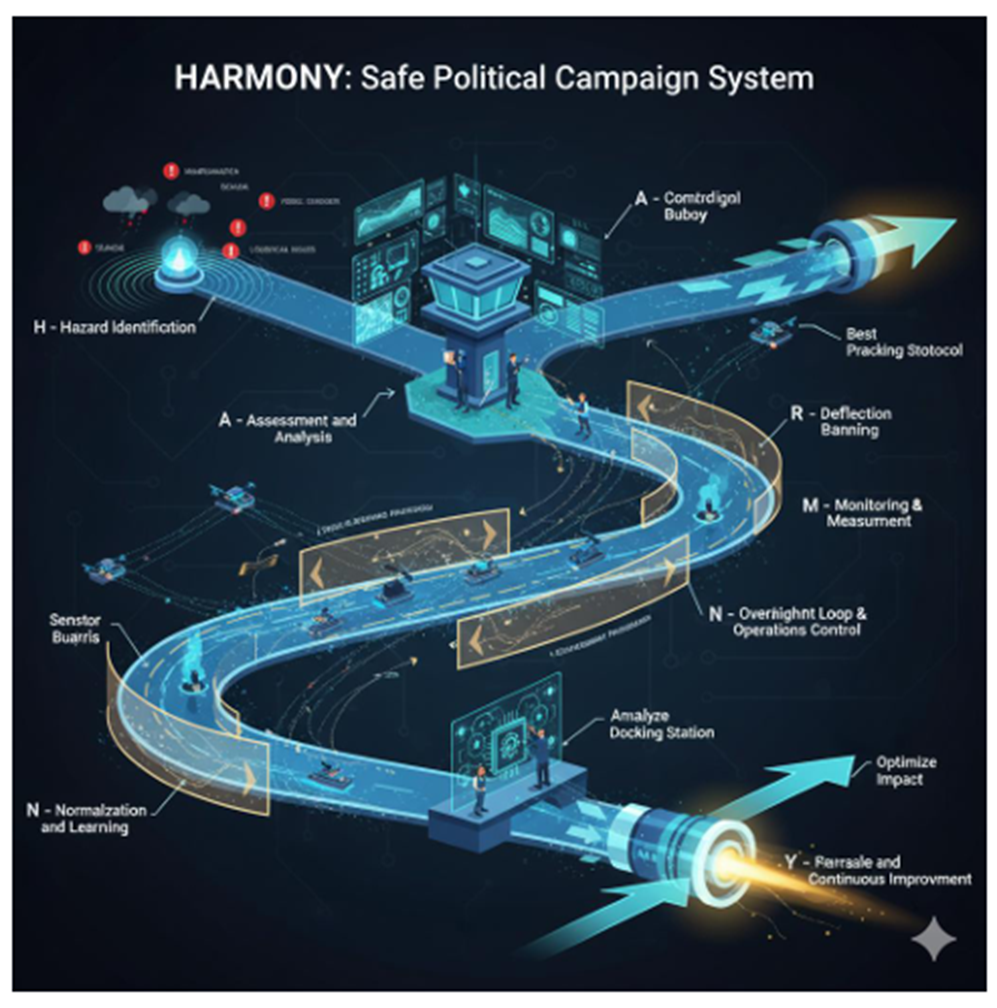
4.3 The H.A.R.M.O.N.Y. Cycle: Systemic Integration
The H.A.R.M.O.N.Y. framework operates as a closed-loop control system, integrating hazard
anticipation, active control, and learning feedback in a continuous cycle:
Pre-Event Phase: Hazard Identification → Risk Assessment → Mitigation Planning
Event Phase: Monitoring and Measurement → Oversight and Operations Control
Post-Event Phase: Normalisation and Learning → Yield and Continuous Improvement →
(feeds back to next event’s Hazard Identification)
This cyclical structure ensures that each campaign event both benefits from accumulated
institutional knowledge and contributes new insights to the evolving safety knowledge base.
The framework explicitly rejects linear, checklist-based approaches in favour of adaptive
learning systems that recognise the complexity and uniqueness of each campaign context.
5 Case Application: The Karur Rally under H.A.R.M.O.N.Y. Analysis
To demonstrate the framework’s diagnostic and preventive utility, we apply H.A.R.M.O.N.Y.
retrospectively to the Karur rally incident, identifying specific failures at each phase and
proposing concrete corrective measures.
On September 27, 2025, a rally organised by a new political party in Karur, Tamil Nadu, turned
into a devastating stampede that claimed the lives of 41 women and injured scores of others.
What began as a promise of welfare and empowerment ended in tragedy, as a surge of
thousands, many from economically weaker sections, rushed toward the distribution counters,
only to be trapped in a space that had no safe exit.
The tragedy was not a random occurrence; it was the predictable outcome of systemic neglect.
Preliminary investigations revealed that the venue lacked capacity assessment, barricade
design approval, and real-time crowd monitoring. Many women had travelled long distances,
waiting for hours under oppressive heat. As confusion spread and the temporary roof structures
began to collapse, panic cascaded through the crowd.
Several victims were mothers and daily wage earners, their only intent being to collect welfare
tokens meant to support their families. In their final moments, they became silent witnesses to
the failure of safety governance, a failure that blurred the line between administrative oversight
and moral responsibility
5.1 The Human Context of Systemic Failure
The Karur 2025 incident reminds us that safety engineering, at its core, is not only about
calculating risks but about protecting lives. Each victim represents a point of data that should
have existed in a risk model, a heatmap, or an evacuation plan. Yet, their absence in planning
transformed a civic gathering into a site of collective trauma.
In this sense, engineering must rediscover its ethical spine: designing systems that acknowledge
vulnerability empathy as functional variables, not afterthoughts.
The H.A.R.M.O.N.Y. framework responds to this moral imperative by embedding human centered principles into every stage of risk management, from hazard detection to continuous learning
5.2 Application of the H.A.R.M.O.N.Y. Framework
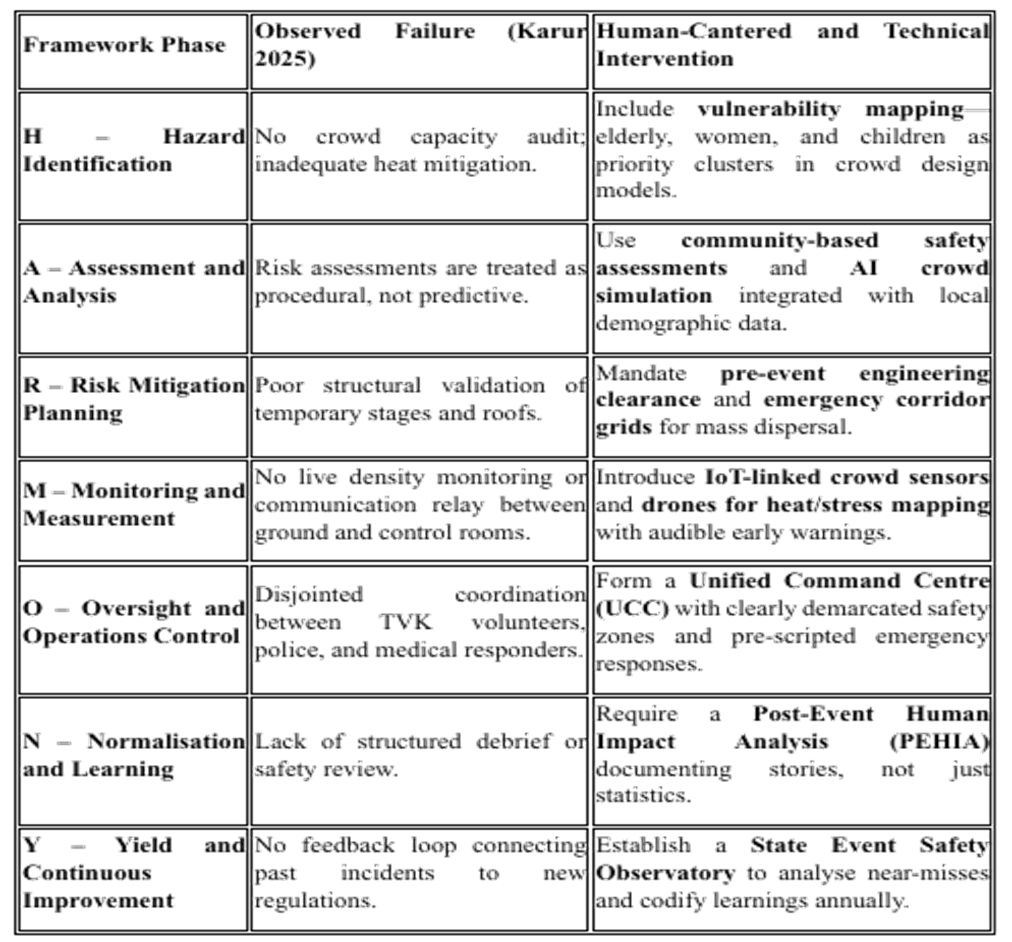
This tragedy thus becomes a mirror for our times: while political campaigns symbolise democracy in motion, they must also reflect democracy in protection. The H.A.R.M.O.N.Y. framework urges policymakers and engineers alike to move from a reactive culture of condolence to a proactive culture of care, where human dignity anchors every safety plan. (Refer to Figure 2)
6. Integration with Global Standards and Frameworks
The H.A.R.M.O.N.Y. framework does not exist in isolation but rather builds upon and
integrates with established international safety and risk management standards. This integration
ensures compatibility with global best practices while maintaining flexibility for local
adaptation.
6.1 ISO 31000:2018 Risk Management
The framework’s risk assessment and mitigation components align directly with ISO 31000’s
principles, emphasising integrated, structured, comprehensive, and customised approaches to
risk management (ISO, 2018). H.A.R.M.O.N.Y. operationalises ISO 31000’s high-level
principles for the specific context of political campaigns
6.2 NDMA Guidelines on Crowd Management (2016)
India’s National Disaster Management Authority provides foundational crowd management
guidelines focused primarily on law enforcement perspectives. H.A.R.M.O.N.Y. extends these
guidelines by integrating engineering analysis, technical hazard assessment, and organisational
learning mechanisms that complement law enforcement functions.
6.3 WHO Mass Gathering Health Risk Assessment (2021)
The World Health Organisation’s framework for assessing health risks at mass gatherings
provides valuable methodologies for medical planning and public health surveillance.
H.A.R.M.O.N.Y. incorporates these health dimensions while expanding the scope to
encompass electrical, structural, and systemic organisational risks.
6.4 Leveson’s STAMP (2012)
The framework’s emphasis on control structures, feedback loops, and system-level thinking
directly derives from STAMP’s system-theoretic approach. H.A.R.M.O.N.Y. applies STAMP’s
principles to the specific domain of political campaigns, recognising accidents as emergent
properties of inadequate constraint enforcement across organisational boundaries.
6.5 IEC 61508 Functional Safety
While developed for industrial electrical systems, IEC 61508’s approach to safety integrity
levels and systematic hazard analysis provides relevant methodologies for assessing electrical
risks in campaign environments. H.A.R.M.O.N.Y. adapts these technical standards to
temporary political infrastructure, establishing equivalent safety requirements appropriate to
the campaign context.
By bridging technical safety standards, risk governance frameworks, and mass gathering
guidelines, H.A.R.M.O.N.Y. translates abstract safety principles into practical democratic
infrastructure management protocols. This integration ensures the framework benefits from
decades of safety engineering evolution while remaining accessible to political organisations
and election authorities.
7. Limitations and Future Research Directions
7.1 Study Limitations
This conceptual study acknowledges several limitations that constrain claims and suggest
caution in interpretation:
Retrospective analysis: Applying the framework retrospectively to past incidents differs from
prospective implementation, where real-world political pressures, resource constraints, and
organisational dynamics introduce complexities not fully captured in conceptual modelling.
Generalizability questions: The framework develops within Indian political contexts; its
applicability to different political systems, campaign cultures, and regulatory environments
requires careful adaptation rather than direct transfer.
Implementation feasibility: While the study proposes implementation mechanisms, actual
political will, resource availability, and institutional capacity for implementation remain
uncertain and context-dependent.
Quantitative validation absence: The study provides a qualitative framework development
without statistical validation of effectiveness metrics, cost-benefit quantification, or controlled
intervention studies demonstrating incident reduction.
Single case application: While the Karur incident provides illustrative value, broader
empirical validation across multiple incidents, regions, and political contexts would strengthen
framework robustness.
8 Future Research Directions
These limitations suggest productive research directions for advancing campaign safety
knowledge:
Empirical Validation Studies
Prospective intervention research: Implementing H.A.R.M.O.N.Y. in selected campaign
contexts with rigorous evaluation comparing safety outcomes, incident rates, and near-miss
frequencies against control groups using conventional practices.
Multi-case comparative analysis: Systematically analysing diverse campaign incidents
across regions, political parties, and event types to identify patterns, validate framework
components, and refine hazard taxonomies.
Longitudinal studies: Tracking safety performance across multiple election cycles to assess
learning effectiveness, organisational culture evolution, and sustainability of safety
improvements.
Technological Development Research
Sensor system development: Engineering research developing purpose-built sensor
technologies optimised for temporary campaign infrastructure, balancing cost, reliability, and
deployment simplicity.
Crowd modelling advancement: Computational research improving crowd flow prediction,
density estimation, and behaviour modelling specific to political rally contexts differing from
sporting events or concerts.
Decision support systems: Developing AI-powered safety decision tools integrating hazard
databases, weather forecasting, and real-time monitoring to provide actionable
recommendations to Safety Command Cells.
Behavioural and Organizational Research
Safety culture assessment: Investigating factors influencing safety culture development in
political organizations, identifying barriers and enablers for cultural transformation.
Multi-agency coordination dynamics: Examining inter-organizational communication,
power dynamics, and coordination mechanisms in campaign safety management to optimize
collaboration structures.
Participant behaviour studies: Understanding crowd behaviour, risk perception, and safety
compliance among campaign participants to inform more effective communication and
intervention strategies.
Policy Analysis and Comparative Studies
Regulatory framework comparison: Analysing campaign safety regulations across countries
and states to identify effective policy mechanisms and implementation models.
Cost-benefit quantification: Rigorous economic analysis quantifying prevention costs versus
incident costs, insurance implications, and optimal resource allocation strategies.
Legal framework development: Jurisprudence research addressing liability questions,
regulatory authority, and legal mechanisms for enforcing campaign safety standards within
democratic rights frameworks.
Ethical and Democratic Theory Research
Safety-democracy balance: Philosophical examination of tensions between safety
requirements and democratic expression, developing principled frameworks for balancing
competing values.
Equity implications: Analysing how safety regulations affect different political parties,
especially resource-constrained organisations, and developing mechanisms ensuring safety
doesn’t become barrier to democratic participation.
Rights framework integration: Legal and political theory research integrating safety
engineering into rights-based frameworks recognising both political participation rights and
rights to safe public spaces.
9 Conclusions
This study has developed and articulated the H.A.R.M.O.N.Y. Framework, as a comprehensive
safety engineering architecture specifically designed for political campaign environments. By
extending established safety engineering principles from industrial contexts to democratic
spaces, the framework addresses a critical gap in public safety governance. Through this article,
we make several significant contributions to safety engineering theory and practice:
Conceptual innovation: Extending safety engineering’s boundaries into socio-political
systems, demonstrating that democratic processes constitute legitimate objects of systematic
safety analysis and intervention.
Methodological synthesis: Integrating diverse safety methodologies—FMEA, STPA, Root
Cause Analysis, and continuous improvement cycles—into a unified framework adapted to
temporary, high-density political environments.
Practical applicability: Providing actionable guidance through detailed component
descriptions, implementation mechanisms, and retrospective case application demonstrating
diagnostic utility.
Policy framework: Proposing concrete regulatory mechanisms including Safety Certification
Systems, Election Commission integration, and legal framework development that translate
conceptual models into institutional realities.
Cross-disciplinary bridge: Connecting safety engineering, political science, public
administration, and democratic theory in productive dialogue, advancing both safety practice
and democratic theory.
Further, H.A.R.M.O.N.Y.’s deeper significance lies in reconceptualising democratic
infrastructure itself. Political campaigns represent not merely logistical events but foundational
democratic rituals through which citizens exercise political agency. When these spaces become
sites of preventable injury and death, democracy itself suffers.
Safety engineering must evolve beyond factories and highways to safeguard the spaces where
citizens gather to shape collective futures. The H.A.R.M.O.N.Y. framework demonstrates that
this evolution is both necessary and achievable—that we can harmonise human enthusiasm
with engineered foresight, political expression with protective design.
Applying such frameworks to political campaigns can reduce preventable accidents, enhance
institutional trust in democratic processes, and redefine political participation as a domain of
responsible engineering ethics rather than improvised risk-taking. In an era where political
mobilisation occurs instantly and massively, designing safety into democracy is not optional—
it is an obligation to citizens, to democratic principles, and to the fundamental precept that
participation in governance should never cost lives.
This study concludes with urgent recommendations for multiple stakeholder groups, i.e.,
Election authorities should integrate campaign safety into regulatory frameworks, leveraging
existing institutional mechanisms to establish certification systems and oversight structures.
Engineering professional bodies should develop specialised competencies in democratic
event safety, creating certification programs and ethical guidelines for engineers working in
political contexts.
Academic institutions should establish research programs investigating campaign safety,
training future safety professionals, and contributing technical expertise to practical
implementation.
Government agencies should allocate resources for safety infrastructure development,
recognising campaign safety as an essential public good worthy of public investment.
Civil society organisations should advocate for safety reforms, monitor implementation, and
ensure accountability for safety failures.
The Karur tragedy and countless similar incidents demonstrate that current approaches fail
democratic values and endanger citizens. The H.A.R.M.O.N.Y. framework provides a path
forward, one requiring commitment, resources, and political will, but promising transformative
improvements in how democracies manage the inherent risks of mass political participation.
References
- Argyris, C., & Schön, D. A. (1978). Organizational learning: A theory of action perspective. Reading, MA: Addison-Wesley.
- Challenger, R., Clegg, C., & Robinson, M. (2009). Understanding crowd behaviours:
- Supporting evidence. UK Cabinet Office Emergency Planning College.
- Dekker, S. (2011). Drift into failure: From hunting broken components to understandingcomplex systems. Farnham, UK: Ashgate.
- Deming, W. E. (2000). Out of the crisis. Cambridge, MA: MIT Press.
- FEMA. (2008). National Incident Management System. Washington, DC: Federal Emergency Management Agency.
- Helbing, D., Johansson, A., & Al-Abideen, H. Z. (2007). Dynamics of crowd disasters: An empirical study. Physical Review E, 75(4), 046109.
- Hollnagel, E. (2014). Safety-I and Safety-II: The past and future of safety management.
- Farnham, UK: Ashgate.
- Hollnagel, E., Woods, D. D., & Leveson, N. (2006). Resilience engineering: Concepts and precepts. Aldershot, UK: Ashgate.
- Hopkins, A. (2014). Issues in safety science. Safety Science, 67, 6-14.
- ISO. (2018). ISO 31000:2018 Risk management — Guidelines. Geneva: International Organization for Standardization.
- Kumar, R., & Singh, A. (2018). Political mobilization and public safety in Indian elections.
- Journal of South Asian Development, 13(2), 178-201.
- Leveson, N. (2012). Engineering a safer world: Systems thinking applied to safety. Cambridge, MA: MIT Press.
- Mevish, Z. A., Zumla, A., Alhakeem, R. F., Assiri, A., Turkestani, A., Al Harby, K. D., … & Al Tawfiq, J. A. (2012). Hajj: Infectious disease surveillance and control. The Lancet, 383(9934), 2073-2082.
- NDMA. (2016). Guidelines on crowd management. New Delhi: National Disaster Management Authority, Government of India.
- NIOSH. (2015). Hierarchy of controls. Cincinnati, OH: National Institute for Occupational Safety and Health.
- Rao, M. S., & Mehta, P. (2019). Safety gaps in mass political gatherings: An Indian perspective.
- International Journal of Disaster Risk Reduction, 36, 101089.
- Reason, J. (1997). Managing the risks of organizational accidents. Aldershot, UK: Ashgate.
- Renn, O. (2008). Risk governance: Coping with uncertainty in a complex world. London: Earthscan.
- Rooney, J. J., & Heuvel, L. N. V. (2004). Root cause analysis for beginners. Quality Progress, 37(7), 45-56.
- Sharma, V. (2020). Political campaign accidents in India: A systematic review. Asian Journal of Public Administration, 42(3), 234-251.
- Stamatis, D. H. (2003). Failure mode and effect analysis: FMEA from theory to execution (2nd ed.). Milwaukee, WI: ASQ Quality Press.
- Still, G. K. (2014). Introduction to crowd science. Boca Raton, FL: CRC Press.
- Vaughan, D. (1996). The Challenger launch decision: Risky technology, culture, and deviance at NASA. Chicago: University of Chicago Press.
- Weick, K. E., & Sutcliffe, K. M. (2015). Managing the unexpected: Sustained performance in a complex world (3rd ed.). Hoboken, NJ: Wiley.
- WHO. (2021). Mass gathering health risk assessment tools. Geneva: World Health Organization.