Electrical panel maintenance is critical for ensuring the safety, reliability, and continuous operation of commercial buildings. However, maintenance activities expose workers and facility stakeholders to various hazards, including electric shock, arc flash, fire incidents, equipment failure, and operational disruptions. These challenges are further intensified by aging electrical infrastructure, high-occupancy environments, and the requirement to maintain uninterrupted business operations with minimal downtime.
This study develops a Context-Specific Safety Framework by integrating Job Hazard Analysis and Risk Management Framework (JHARMF) into electrical panel maintenance activities within commercial facilities. The research was conducted using a mixed-method approach involving site observations during electrical maintenance activities, structured interviews, reviews of Permit-to-Work (PTW) practices, and observations of Lockout/Tagout (LOTO) implementation and maintenance procedures. Data were collected from 200 respondents, comprising facility managers, electrical engineers, safety professionals, maintenance technicians, contractors, and other relevant stakeholders involved in building operations and maintenance.
The proposed framework systematically identifies hazards, assesses risk levels, and recommends appropriate control measures across key maintenance stages, including panel isolation, inspection, testing, repair, replacement, and re-energization. A qualitative risk matrix based on severity and likelihood was utilized to prioritize risks and support informed decision-making. The findings indicate that effective integration of hazard identification, risk assessment, PTW compliance, and LOTO implementation significantly improve maintenance safety performance and reduces the likelihood of incidents.
The study contributes a practical and scalable framework that enhances maintenance planning, stakeholder coordination, regulatory compliance, and asset reliability while minimizing operational disruptions. The proposed JHARMF-based approach provides commercial building operators with an effective tool for achieving safer and more sustainable electrical maintenance practices.
panel maintenance is essential for ensuring the safety, reliability, and uninterrupted operation of commercial buildings. However, maintenance activities expose workers and building stakeholders to hazards such as electric shock, arc flash, fire, equipment failure, and operational disruptions, these challenges are heightened by high-occupancy facilities, aging electrical infrastructure, and the need to maintain continuous business operations with minimal downtime.
This study proposes a Context-Specific Safety Framework that integrates Job Hazard Analysis and Risk Management Framework (JHARMF) into electrical panel maintenance within commercial facility operations. The framework systematically identifies maintenance-related hazards, evaluates associated risks, and recommends appropriate control measures throughout key activities, including panel isolation, inspection, testing, repair, and re-energization. It also addresses the concerns of key stakeholders, including maintenance personnel, facility managers, tenants, occupants, contractors, and building owners, who are affected by safety risks, service interruptions, compliance requirements, and operational costs.
By combining hazard analysis with risk-based decision-making, the proposed framework enhances maintenance planning, stakeholder coordination, and safety performance. The study aims to reduce workplace incidents, improve regulatory compliance, minimize operational disruptions, and increase asset reliability. The framework offers a practical and scalable approach based on the interviews that can support safer and more effective electrical maintenance practices across commercial buildings.
2. Introduction
Electrical systems constitute the backbone of modern commercial buildings, supporting critical operations such as lighting, heating, ventilation, air conditioning (HVAC), fire protection systems, information technology infrastructure, and tenant services. Electrical panels, as key distribution and control points, require periodic inspection, testing, repair, and maintenance to ensure operational reliability and safety. However, electrical panel maintenance remains one of the highest-risk activities in facility management due to potential exposure to electrical shock, arc flash, equipment failure, and fire hazards. Such incidents can result in injuries, asset damage, operational downtime, financial losses, and reputational impacts for building owners and operators.
In commercial facilities, the complexity of electrical maintenance is further influenced by high occupancy levels, uninterrupted business requirements, aging infrastructure, and increasing regulatory expectations related to workplace health and safety. Planned or unplanned maintenance activities often affect multiple stakeholders, including maintenance personnel, facility managers, contractors, tenants, occupants, and property owners. Consequently, there is a growing need for a structured and proactive approach to hazard identification and risk control that supports both safety and operational continuity.
Job Hazard Analysis (JHA) is widely recognized as an effective tool for identifying task-specific hazards, while risk management practices provide mechanisms for evaluating and controlling associated risks. However, these approaches are often implemented independently, limiting their effectiveness in complex facility environments. This study addresses this gap by proposing the integration of a Job Hazard Analysis and Risk Management Framework (JHARMF) into electrical panel maintenance activities.
The research aims to develop a context-specific safety framework tailored to commercial facility operations, enabling systematic hazard assessment, improved stakeholder coordination, enhanced regulatory compliance, and safer maintenance execution. The proposed framework seeks to strengthen risk-informed decision-making while minimizing accidents, operational disruptions, and asset-related failures.
3. Review
Literature Review
Electrical panel maintenance is a high-risk activity within commercial building operations, requiring a systematic approach to hazard identification, risk assessment, and control. The integration of Job Hazard Analysis (JHA) and Risk Management Frameworks (RMFs) has gained increasing attention in occupational safety research due to its ability to proactively identify hazards, reduce incidents, and improve decision-making. This literature review examines recent research and industry standards related to hazard analysis, risk management, electrical safety, and stakeholder impacts in maintenance operations, thereby establishing the foundation for the proposed Integrated Job Hazard Analysis and Risk Management Framework (JHARMF) for commercial facility operations.
Electrical Panel Maintenance and Occupational Safety
Electrical distribution systems are essential for the operation of modern commercial facilities, supporting HVAC systems, lighting, data centers, elevators, and fire safety infrastructure. Maintenance activities such as inspection, testing, troubleshooting, component replacement, and panel energization expose workers to hazards including electric shock, arc flash, arc blast, and fire. NFPA 70E recognizes electrical work as one of the most hazardous maintenance activities and emphasizes risk assessment as a prerequisite for safely performing work on or near energized equipment. The standard promotes a hierarchy of controls, prioritizing hazard elimination through de-energization, followed by engineering controls, administrative controls, and personal protective equipment (PPE).
Recent studies also highlight that poor maintenance practices, inadequate training, and failure to conduct systematic risk assessments significantly increase the likelihood of electrical incidents. As commercial buildings increasingly depend on uninterrupted electrical supply, maintenance safety has become a critical component of business continuity and organizational resilience.
Job Hazard Analysis as a Proactive Safety Tool
Job Hazard Analysis (JHA), also known as Job Safety Analysis (JSA), is a structured technique used to identify hazards associated with specific work activities and determine appropriate control measures before work begins. The effectiveness of JHA lies in its task-based approach, which breaks complex operations into sequential steps, enabling hazards to be identified systematically.
Kwon et al. (2024) developed a Hazard Identification and Risk Assessment of Simultaneous Operations (HIRAS) model based on Job Safety Analysis to improve maintenance safety in industrial environments. Their study demonstrated that the integration of structured hazard identification with risk assessment significantly improves the detection of hazardous interactions between concurrent maintenance activities. The findings support the application of JHA as an effective mechanism for improving safety performance in complex maintenance operations.
In electrical panel maintenance, JHA is particularly valuable because hazards vary according to the task being performed, equipment condition, work environment, and operational constraints. Research indicates that task-specific hazard identification improves risk visibility and supports the selection of targeted control measures that reduce incident frequency and severity.
Risk Management Frameworks in Occupational Safety
The transition from reactive safety management to proactive risk management has been a major theme in recent occupational health and safety research. Modern risk management frameworks emphasize continuous hazard identification, risk evaluation, control implementation, performance monitoring, and stakeholder participation.
ISO 45001:2018 provides a globally recognized framework for occupational health and safety management based on risk-based thinking. The standard requires organizations to systematically identify hazards, evaluate risks, implement controls, and continuously improve safety performance through worker participation and leadership commitment.
Bazaluk et al. (2024) proposed an improved occupational risk management model using the Bow-Tie methodology integrated with ISO 45001 principles. Their findings indicate that combining hazard identification with consequence analysis provides a more comprehensive understanding of risk pathways and facilitates better preventive and corrective actions.
Similarly, Hollá et al. (2024) emphasized that effective workplace safety depends on a structured risk assessment process supported by consistent methodologies. Their research demonstrated that organizations using systematic risk management approaches achieved improved hazard control and more effective decision-making.
These findings indicate that integrating JHA with established risk management frameworks can create a stronger and more comprehensive safety management system than either approach used independently.
Electrical Safety Standards and Maintenance Risk Control
Electrical maintenance safety is increasingly governed by standards that link maintenance quality with workplace risk management. NFPA 70B underwent a significant transformation in 2023, evolving from a recommended practice into a formal standard requiring documented maintenance programs, inspections, testing, and risk management procedures. NFPA 70B emphasizes preventive and condition-based maintenance to minimize electrical failures and workplace hazards.
According to industry reports, thousands of electrical malfunction fires continue to occur annually in non-residential buildings, resulting in substantial property losses and operational disruption. These incidents often originate from deteriorated equipment, loose connections, poor maintenance practices, and inadequate inspection programs. Preventive maintenance and documented risk assessment procedures are therefore recognized as essential components of facility risk management.
NFPA 70E further reinforces the importance of electrical risk assessments, emphasizing arc flash analysis, energized work permits, lockout/tagout (LOTO) procedures, and worker competency requirements. These principles provide a strong foundation for integrating JHA and risk management practices into electrical panel maintenance activities.
Stakeholder Impact during Maintenance Operations
Commercial buildings represent complex operational environments involving multiple stakeholders, including maintenance personnel, facility managers, building occupants, tenants, contractors, and property owners. Maintenance-related risks extend beyond worker safety and can affect operational continuity, organizational productivity, regulatory compliance, and customer satisfaction.
Research on occupational safety management increasingly highlights the importance of stakeholder engagement in risk management processes. ISO 45001 specifically identifies worker participation and stakeholder consultation as critical elements for effective safety management.
For facility managers, electrical maintenance introduces challenges associated with coordination, resource allocation, permit-to-work systems, and service continuity. Tenants and occupants may experience power interruptions, reduced business productivity, and safety concerns during maintenance activities. Building owners face financial risks related to equipment failure, regulatory non-compliance, insurance claims, and reputational damage. Consequently, successful maintenance programs must consider stakeholder impacts alongside technical and safety requirements.
4. Research Gap
The literature demonstrates extensive research on Job Hazard Analysis, occupational risk management, ISO 45001 implementation, and electrical safety standards. However, limited studies have focused specifically on integrating JHA and risk management into a unified framework for electrical panel maintenance within commercial operational buildings. Existing studies predominantly address industrial plants, manufacturing environments, or generic safety management systems, with little emphasis on the unique operational challenges of commercial facilities.
Furthermore, stakeholder impacts during maintenance activities are often discussed independently of technical risk assessment processes. There remains a need for a context-specific framework that integrates hazard identification, risk evaluation, maintenance planning, stakeholder communication, and safety control measures within a single operational model
5. Methodology
5.1 Research Approach
This study adopts a qualitative risk-based research approach to develop and validate an integrated Job Hazard Analysis and Risk Management Framework (JHARMF) for electrical panel maintenance in commercial operational buildings. The methodology combines hazard identification, risk assessment, compliance evaluation, and stakeholder analysis to establish a practical safety framework that can be adopted by facility management organizations. The framework is designed to align with internationally recognized occupational health and electrical safety principles, including risk-based thinking, preventive maintenance, and continuous improvement. ISO 45001 emphasizes systematic hazard identification, risk assessment, worker participation, and continual improvement as core elements of occupational safety management systems.
5.2 Study Scope and Context
The research focuses on electrical panel maintenance activities conducted in operational commercial facilities, including office buildings, business parks, mixed-use developments, shopping complexes, and IT campuses. Maintenance activities examined in this study include inspection, isolation, lockout/tagout (LOTO), testing, cleaning, component replacement, troubleshooting, commissioning, and re-energization of electrical panels.
The framework considers the safety and operational impacts on key stakeholders, including maintenance personnel, facility managers, contractors, tenants, occupants, and building owners. Since commercial buildings require continuous electrical service and minimal downtime, the study emphasizes the integration of safety management with operational continuity.
5.3 Data Collection
Data for the study are collected using both primary and secondary sources.
Primary data sources include:
- Site observations during electrical maintenance activities.
- Interviews with facility managers, electrical engineers, safety professionals, and maintenance technicians.
- Review of permit-to-work (PTW) practices.
- Observation of lockout/tagout implementation and maintenance procedures.
Secondary data sources include:
- Maintenance records and incident reports.
- Standard operating procedures (SOPs).
- Safety audit reports.
- Equipment maintenance manuals.
- Regulatory standards, codes, and electrical safety guidelines.
The use of multiple data sources facilitates triangulation and enhances the reliability of the proposed framework.
5.4 Job Hazard Analysis Process
Job Hazard Analysis (JHA) serves as the primary hazard identification tool within the proposed methodology. Each maintenance activity is systematically divided into sequential tasks, and potential hazards associated with each task are identified.
The JHA process consists of:
- Selection of maintenance activity.
- Breakdown of the activity into individual job steps.
- Identification of hazards associated with each step.
- Determination of existing control measures.
- Recommendation of additional controls where necessary.
Typical hazards considered include electrical shock, arc flash, arc blast, fire, equipment failure, falls, ergonomic risks, and inadvertent energization. Recent studies have demonstrated that structured job safety analysis significantly improves hazard recognition and enhances risk identification during maintenance operations.
5.5 Risk Assessment Method
Following potential hazard identification of the maintenance activities for electrical panel, a structured risk assessment is performed to evaluate the likelihood and consequences of identified hazards. Risk levels are determined using a risk matrix that combines probability and severity ratings.
| Activity | Potential Hazard |
|---|---|
| Shutdown and Isolation | Electricity High voltage exposure & shock potential |
| LOTO Implementation | Incomplete isolation Residual stored electrical/mechanical energy |
| Panel Opening | Arc flash Explosive thermal blast & high incident energy |
| Inspection | Contact with live parts Inadvertent physical bridging |
| Cleaning | Conductive contamination Moisture, metallic dust & chemical tracking |
| Component Replacement | Wrong connections Phase mismatch, loose torque & polarity reversal |
| Testing and Commissioning | Unexpected energization Premature switching & backfeed |
| Restoration | Equipment failure Transient overvoltage, short circuit & insulation breakdown |
5.6 Risk Classification Matrix
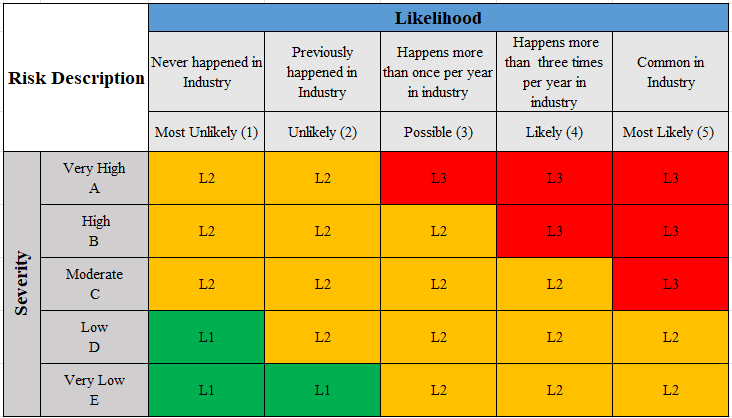
Based on the Risk classification Matrix, Risk is calculated as:
The identified risks are categorized into low, medium, high, and critical risk levels. The assessment process follows the risk-based principles established in ISO 45001, which require organizations to identify workplace hazards and implement controls proportional to the level of risk.
The hierarchy of controls is then applied to determine suitable mitigation measures. Priority is given to hazard elimination and substitution, followed by engineering controls, administrative controls, and personal protective equipment (PPE).
5.7 JHARM Format
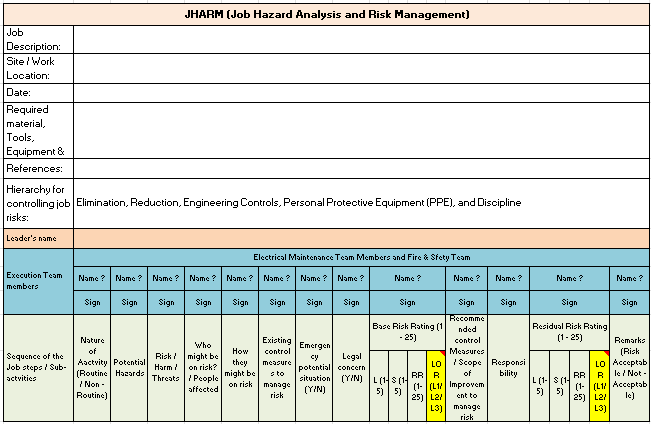
The format shown in the figure represents an integrated Job Hazard Analysis and Risk Management (JHARM) tool designed to systematically identify, assess, control, and monitor occupational risks associated with maintenance activities. Unlike conventional Job Hazard Analysis (JHA), which focuses primarily on hazard identification, JHARM integrates both hazard analysis and quantitative risk management, enabling organizations to evaluate residual risk after implementing control measures.
For electrical panel maintenance in commercial operational buildings, the framework serves as a decision-support tool that aligns maintenance activities with occupational safety requirements, engineering controls, regulatory compliance, and stakeholder protection.
5.8 Evaluation of Standard Operating Procedures (SOPs)
A critical component of the methodology involves assessing the adequacy and implementation of Standard Operating Procedures related to electrical maintenance activities. SOPs provide consistent guidance for performing maintenance tasks safely and efficiently while reducing the impact of human error.
The evaluation focuses on:
- Equipment isolation procedures.
- Lockout/tagout practices.
- Permit-to-work requirements.
- PPE requirements.
- Emergency response procedures.
- Re-energization protocols.
- Communication and stakeholder notification processes.
Adherence to documented procedures is essential for minimizing electrical incidents and ensuring consistency in maintenance execution. NFPA 70E emphasizes the implementation of safe work practices and documented risk assessment procedures for electrical work.
5.9 Engineering Guidelines and Maintenance Controls
The proposed framework incorporates engineering best practices to strengthen electrical safety and system reliability. Engineering controls are evaluated because they provide a more effective and sustainable approach to risk reduction than administrative controls alone.
The assessment includes:
- Verification of single-line diagrams (SLDs).
- Protective relay coordination studies.
- Circuit breaker performance evaluation.
- Earthing system verification.
- Thermographic inspection of panels.
- Insulation resistance testing.
- Contact resistance measurement.
- Condition-based maintenance practices.
The transition toward preventive and condition-based maintenance has been strongly advocated in recent electrical maintenance standards, which recognize maintenance as an essential component of risk management and operational reliability.
5.10 Inspection Checklist Development
The checklist serves as a practical tool for evaluating compliance before, during, and after maintenance activities.
The checklist addresses:
- Documentation verification.
- Worker competency assessment.
- Availability and use of PPE.
- LOTO implementation.
- Equipment condition assessment.
- Electrical testing requirements.
- Housekeeping and access control.
- Emergency preparedness measures.
The checklist also supports regulatory audits and facilitates continuous monitoring of maintenance quality and safety performance.
5.11 Framework Development and Validation
The final JHARMF is developed by integrating findings from hazard analysis, risk assessment, SOP evaluation, engineering controls, compliance reviews, and stakeholder considerations into a unified safety framework.
Validation of the framework is achieved through expert review involving facility managers, electrical engineers, safety professionals, and maintenance contractors. Their feedback is used to assess practicality, applicability, completeness, and alignment with industry requirements.
The outcome of this methodology is a context-specific safety framework that supports risk-informed decision-making, regulatory compliance, stakeholder protection, and enhanced reliability of electrical maintenance activities in commercial buildings. The framework ultimately seeks to reduce electrical incidents, minimize operational disruptions, improve maintenance effectiveness, and strengthen facility safety performance.
5.12 JHARMF Model
5.13 Continuous Improvement Mechanism
References
- Bazaluk, O., Tsopa, V., Okrasa, M., Pavlychenko, A., Cheberiachko, S., Yavorska, O., Deryugin, O., & Lozynskyi, V. (2024). Improvement of the occupational risk management process in the work safety system of the enterprise. Frontiers in Public Health, 11, Article 1330430. https://doi.org/10.3389/fpubh.2023.1330430
- Bureau of Indian Standards. (2019). IS 3043: Code of practice for earthing. BIS, New Delhi.
- Bureau of Indian Standards. (2015). IS 5216 (Part 1 & 2): Recommendations on safety procedures and practices in electrical work. BIS, New Delhi.
- Central Electricity Authority. (2023). CEA (Measures Relating to Safety and Electric Supply) Regulations. Ministry of Power, Government of India.
- Eaton Corporation. (2023). Understanding 2023 NFPA 70B: Standard for electrical equipment maintenance. Eaton White Paper.
- Hollá, K., Kuricová, A., Kočkár, S., Prievozník, P., & Dostál, F. (2024). Risk assessment industry-driven approach in occupational health and safety. Frontiers in Public Health, 12, 1381879. https://doi.org/10.3389/fpubh.2024.1381879
- International Electrotechnical Commission (IEC). (2019). IEC 60364: Low-voltage electrical installations. IEC, Geneva, Switzerland.
- International Electrotechnical Commission (IEC). (2020). IEC 61439: Low-voltage switchgear and controlgear assemblies. IEC, Geneva, Switzerland.
- International Organization for Standardization. (2018). ISO 45001:2018 Occupational health and safety management systems—Requirements with guidance for use. ISO, Geneva, Switzerland.
- Kwon, S. J., Choi, S. W., & Lee, E. B. (2024). Hazard identification and risk assessment during simultaneous operations in industrial plant maintenance based on job safety analysis. Sustainability, 16(21), 9277. https://doi.org/10.3390/su16219277
- Ministry of Law and Justice. (2003). The Electricity Act, 2003. Government of India.
- National Fire Protection Association. (2024). NFPA 70E: Standard for electrical safety in the workplace. NFPA, Quincy, MA.
- National Fire Protection Association. (2023). NFPA 70B: Standard for electrical equipment maintenance. NFPA, Quincy, MA.
- National Institute of Building Sciences. (2023). Best practices in facility maintenance risk management and electrical safety. Journal of Facility Management and Safety Engineering, 15(2), 45-58.
- National Building Code of India. (2016). National Building Code of India 2016 (Part 8: Building Services – Electrical Installations). Bureau of Indian Standards, New Delhi.
- Occupational Safety and Health Administration. (2024). Electrical safety-related work practices (29 CFR 1910 Subpart S). U.S. Department of Labor.
- Walters, E. (2026). Electrical safety compliance under NFPA 70B: Managing risk through preventive maintenance. Facilities Management Insights. https://www.facilitiesnet.com